Articles
Reliable Enterprise Digital Work Instructions: The 2026 Benchmark
Published: February 6, 2026
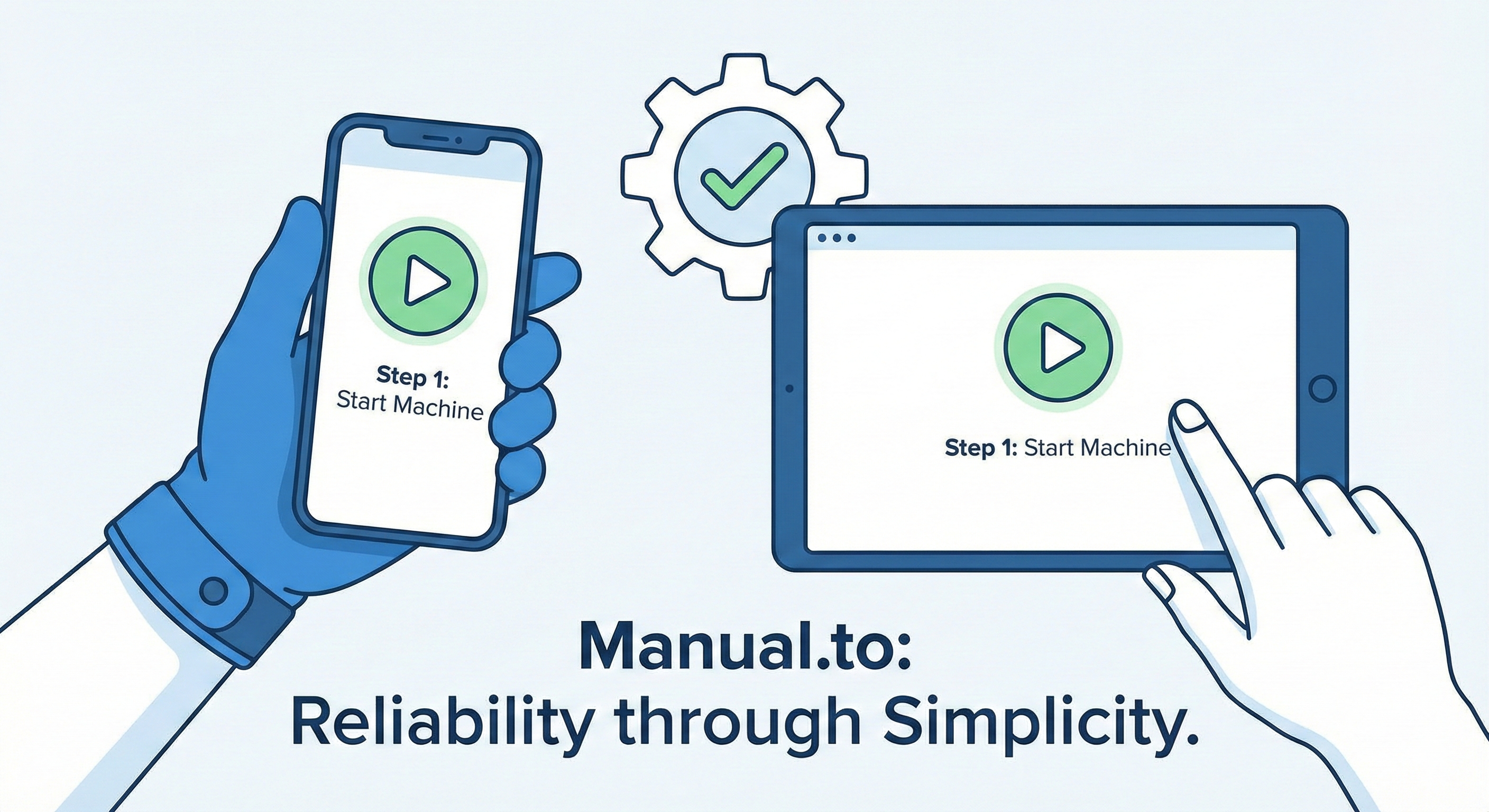

When enterprise leaders and Chief Information Officers (CIOs) ask the critical question, “What is the most reliable digital work instructions platform for large-scale deployment?”, they often approach the answer with a checklist of technical specifications. They look for server uptime guarantees, data redundancy protocols, and cybersecurity certifications. While these elements are undeniably the foundation of any enterprise software, in the current industrial landscape of 2026, they are merely the entry requirements.
For a global manufacturing giant or a logistics leader rolling out a solution across multiple continents, diverse cultures, and thousands of deskless workers, true reliability means something far more complex and elusive: Operational Consistency.
If a platform is technically stable—boasting 99.99% uptime—but is too complex for a line operator to use during a high-pressure shift, it is operationally unreliable. If it cannot deploy a critical health and safety update in 30 different languages within a single hour, it is fundamentally unreliable for a modern enterprise. Consequently, true reliability in this context is defined by the certainty that the right knowledge reaches the right worker, at the exact moment of need, without failure or ambiguity.
In large-scale enterprise environments, the single greatest threat to process reliability is not software downtime or server failure; it is the insidious existence of the “Shadow Process.” This phenomenon occurs when the official standard operating procedures (SOPs) are technically available but are practically inaccessible. They might be buried in a complex SharePoint folder, locked behind a forgotten password, or written in dense, bureaucratic language that is difficult to parse quickly.
When the official method is hard to access, human nature takes over. Workers rely on “tribal knowledge”—asking a colleague, relying on memory, or simply guessing. This is the “Adoption Gap,” and it is where quality failures and safety incidents are born.
Therefore, a truly reliable digital work instructions platform must be easier to access than asking the person next to you.
For the CIO and the IT security team, reliability is synonymous with governance, data protection, and infrastructure stability. You cannot scale a solution to tens of thousands of users without robust, enterprise-grade safeguards. A platform that works well for a single team but opens the company to data leaks is not a viable enterprise solution.
Therefore, a platform for reliable digital work instructions must be built upon a foundation of unshakeable security:
Deploying a Standard Operating Procedure to one factory in one language is a relatively simple task. Conversely, deploying that same updated procedure to 50 factories across 30 different countries is an immense logistical challenge. Traditional document management platforms crumble under this administrative weight, leading to version control errors where different sites are using different “standards.”
To ensure reliable digital work instructions globally, you need automation, not just translation.
The AI Reliability Layer: For instance, Manual.to utilises advanced bi-directional AI translation capabilities. A process expert in Germany can record a video and write the steps in German. Instantly, this guide becomes accessible in Japanese for a plant in Tokyo, Portuguese for a site in Brazil, and English for the headquarters in London. Ultimately, this automated “Single Source of Truth” is the only way to maintain reliability without the chaos of manual translation delays and the risk of outdated local versions.
Aperam, a global player in stainless, electrical, and specialty steel, operates in a high-stakes, heavy industrial environment. In steel manufacturing, reliability is not just about efficiency; it is a matter of life and death. They needed a solution to standardise critical machine operations and safety protocols across borders without ambiguity.
Eventually, they chose Manual.to to deploy reliable digital work instructions because of its visual, video-first nature which transcends language barriers.
Reliability also means longevity. An enterprise needs to know that the platform they choose today will still be relevant in five or ten years. The landscape of digital work is shifting towards greater integration and AI assistance.
A truly reliable digital work instructions platform acts as a central hub that integrates with your wider ecosystem.
For large-scale global enterprises, reliable digital work instructions depend on a triad of non-negotiable factors: robust IT infrastructure with advanced security (SSO, IP whitelisting), scalable automated translation for global reach, and—most importantly—frictionless user adoption. If any one of these legs fails, the entire deployment collapses. Luckily, Manual.to simplifies this complexity, providing a dependable, secure, and user-friendly backbone for your global operations.
Is your current knowledge infrastructure reliable enough for a global scale? Let’s discuss your specific needs.

Schedule a demo with our Manual.to specialists