When your best operators retire, decades of tribal knowledge walks out the door. Here's how to capture and transfer critical skills before it's too late. Without proper upskilling, things go wrong.
12 min read
At ArcelorMittal's steel plant in Luxembourg, master operator Klaus Weber had perfected a furnace temperature control technique that reduced energy consumption over his 18-year career. He retired last spring. Three months later, newer operators struggled to replicate his method. The technique died with his departure because no one had filmed him doing it.
This scenario repeats across manufacturing every day. The World Economic Forum reports that 39% of workers' core skills will change by 2030, yet most companies still rely on shoulder-tapping and verbal explanations to transfer knowledge. The result? Critical expertise vanishes when experts leave.
What is upskilling in manufacturing?

Manufacturing upskilling is the systematic process of capturing expert knowledge and transferring it to other workers before critical skills are lost. Unlike classroom training or certification programs, industrial upskilling focuses on preserving the procedural knowledge that exists only in the heads of experienced operators.
This knowledge includes the subtle adjustments a machinist makes based on vibration patterns, the way a quality inspector spots defects that automated systems miss, or the sequence a maintenance technician uses to troubleshoot complex equipment failures. These skills develop over years of hands-on experience and cannot be learned from manuals.
Manufacturing upskilling differs from general workforce development in three key ways:
- Physical procedures: Most manufacturing knowledge involves hands-on tasks that require visual demonstration
- Point-of-need access: Workers need information immediately at their workstation, not in a classroom
- Multilingual workforce: Instructions must be accessible in multiple languages for diverse teams
Why traditional upskilling fails on the production floor
Most upskilling programs fail because they treat manufacturing workers like office employees. They create PowerPoint presentations, written procedures, and classroom sessions that disconnect learning from actual work.
Access Barriers
Workers can't leave production lines for training sessions. Critical procedures happen during off-shifts when trainers aren't available.
Format Mismatch
Written SOPs describe what to do but not how to do it. A 20-page document can't capture the muscle memory of adjusting a machine by sound.
Language Gaps
Procedures written in one language exclude non-native speakers. Professional translation costs make multilingual documentation prohibitively expensive.
Knowledge Hoarding
Experts resist documenting procedures because traditional methods require hours of writing. They'd rather just show someone quickly.
The fundamental problem is that manufacturing knowledge is procedural and contextual. You can't learn welding from a textbook any more than you can learn to ride a bicycle from written instructions. Yet most upskilling programs try to force physical skills into text-based formats.
The hidden cost of undocumented expertise
When an expert retires, companies lose more than an employee. They lose institutional knowledge that took decades to develop. SHRM research shows that 89% of organizations report upskilling is more cost-effective than hiring new talent, yet most wait until after the expert leaves to realize what they've lost.
Consider the true replacement cost of one retiring expert:
| Cost Category | Typical Range | Example |
|---|---|---|
| Recruitment | €8,000-€15,000 | Headhunter fees, interview time, background checks |
| Onboarding | €12,000-€25,000 | Extended training period at reduced productivity |
| Training | €5,000-€20,000 | Formal courses, mentor time, trial-and-error learning |
| Lost productivity | €20,000-€100,000 | Slower cycle times, higher error rates, equipment downtime |
| Knowledge gaps | €50,000-€200,000 | Emergency repairs, rework, safety incidents |
The total cost of replacing one expert ranges from €95,000 to €360,000. For a plant with 10 operators over age 55, the knowledge retention risk reaches €950,000 to €3.6 million.
Visual knowledge capture: The overlooked upskilling method
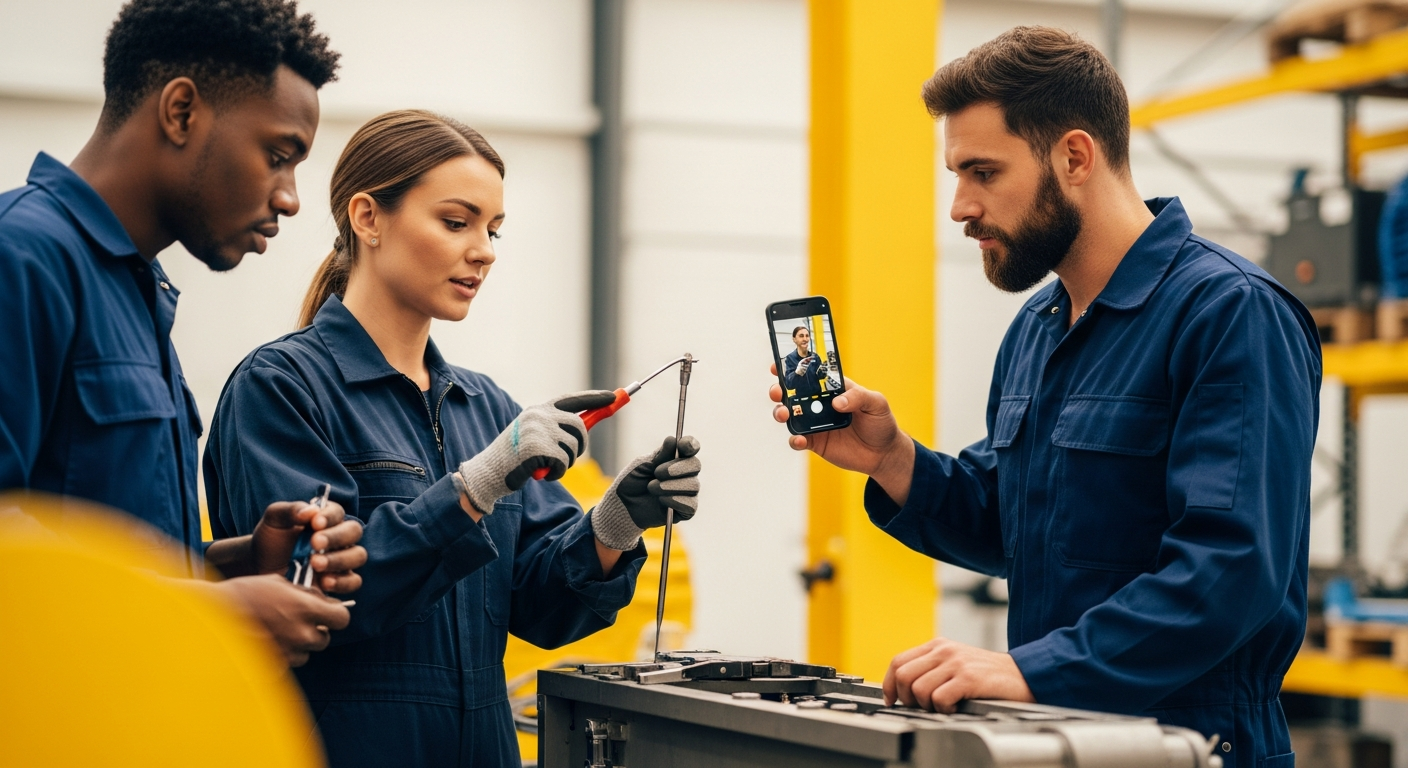
The most effective manufacturing upskilling happens through visual knowledge capture. Instead of asking experts to write procedures, you film them performing the task. This approach works because it aligns with how manufacturing knowledge actually exists and transfers.
Visual knowledge capture solves the core problems of traditional upskilling:
Record the Expert
Film the most skilled operator performing the procedure. No script needed, no special equipment. Just document what they actually do, not what they think they should do.
AI Processing
Modern platforms can automatically break video into step-by-step guides in under 60 seconds. Each step gets a key frame, description, and timing.
Point-of-Need Access
Deploy guides via QR codes on equipment. Workers scan with their phones and get instructions in their preferred language, instantly.
Continuous Improvement
Update procedures by filming new techniques. Version control ensures everyone works from the latest method.
Tools like Manual.to make this process seamless by combining video capture with AI-powered guide creation and instant translation into 200+ languages. The expert films once, and the knowledge becomes accessible to the entire multilingual workforce.
Building a knowledge retention upskilling system
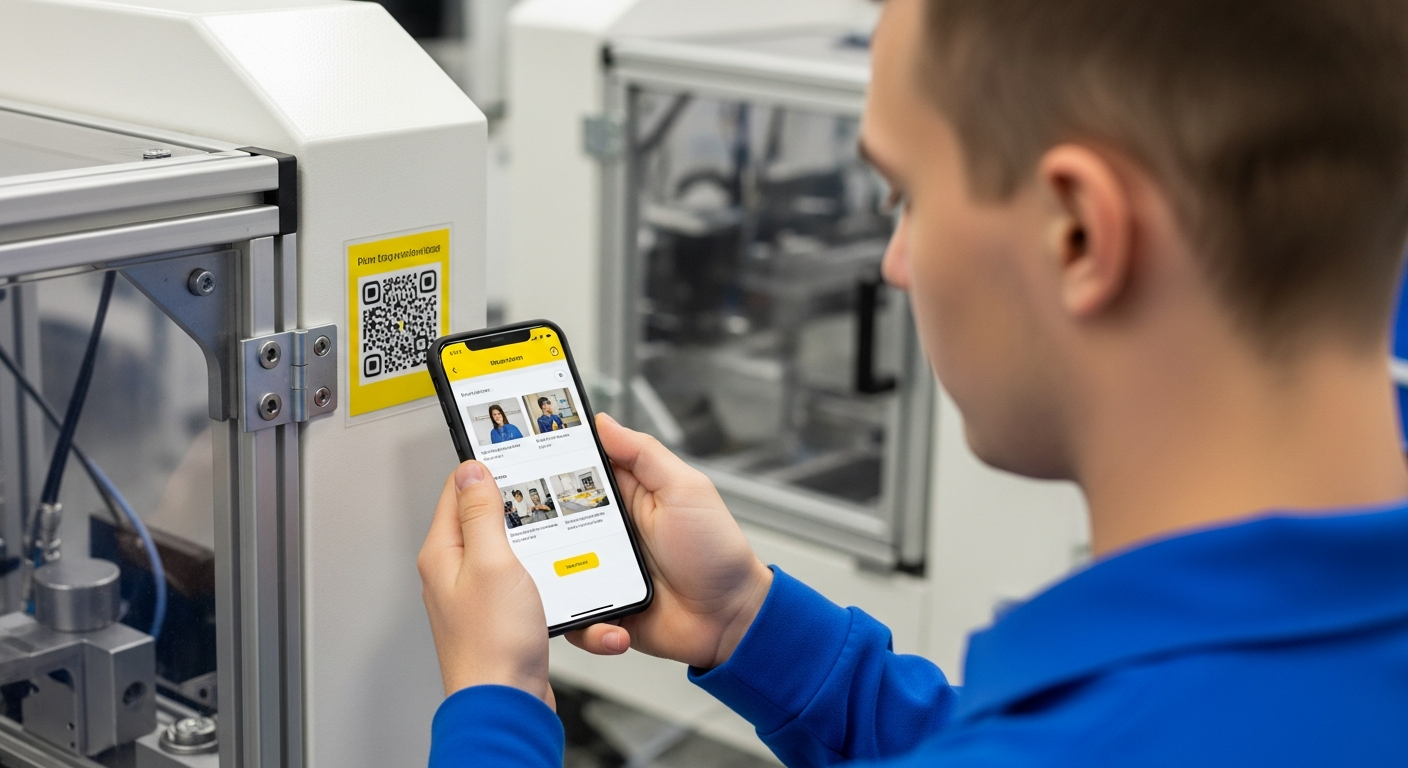
Effective manufacturing upskilling requires a systematic approach to identify, capture, and deploy critical knowledge before it disappears. Here's how to build a sustainable knowledge retention system:
Step 1: Conduct a Knowledge Risk Assessment
Identify which knowledge is most at risk of disappearing. Focus on:
- Workers over 55 with unique skills or responsibilities
- Procedures that only 1-2 people know how to perform
- Tasks that cause significant downtime when done incorrectly
- Safety-critical procedures with high consequences for errors
Step 2: Prioritize Capture Opportunities
Not all knowledge needs immediate documentation. Prioritize based on:
| Risk Level | Criteria | Action Timeline |
|---|---|---|
| Critical | 1 expert, retiring within 12 months, high business impact | Document within 30 days |
| High | 2 experts, retiring within 24 months, moderate business impact | Document within 90 days |
| Medium | 3+ experts, stable workforce, lower business impact | Document within 6 months |
Step 3: Establish Capture Workflows
Create simple processes that experts can follow without disrupting production:
- Schedule 2-hour filming sessions during low-demand periods
- Pair experts with colleagues who can operate cameras
- Focus on complete procedures, not partial demonstrations
- Allow experts to review and approve guides before deployment
Step 4: Deploy at Point of Need
Make knowledge instantly accessible where work happens:
- QR codes on equipment and workstations
- Integration with existing safety and employee onboarding systems
- Mobile-first design for smartphone and tablet access
- Offline capability for areas with poor connectivity
Measuring upskilling ROI beyond retention rates
Most companies measure upskilling success through employee retention and satisfaction surveys. While these metrics matter, manufacturing upskilling delivers measurable operational improvements that provide stronger ROI justification.
The World Economic Forum identifies reduction in mean-time-to-repair (MTTR) as a key metric for measuring training ROI in industrial settings.
| Metric | Baseline Measurement | Target Improvement | Business Impact |
|---|---|---|---|
| First-pass yield | Defect rate by operator skill level | Error rate reduction | Reduced rework costs |
| Time to competency | Months to reach full productivity | Faster onboarding | Lower training costs |
| MTTR | Average repair time by skill level | Faster resolution | Increased equipment uptime |
| Safety incidents | Incident rate during training period | Reduced accidents | Lower insurance premiums |
| Knowledge retention | Procedures at risk when experts leave | Critical knowledge captured | Reduced replacement costs |
To establish baseline measurements, track these metrics before implementing visual knowledge capture systems. Then measure improvements quarterly to demonstrate upskilling ROI.
What most upskilling approaches get wrong
The conventional wisdom says upskilling means sending workers to training courses, earning certifications, or completing online modules. This approach fails in manufacturing because it separates learning from doing.
Real manufacturing upskilling happens when workers can access expert knowledge instantly at their workstation. A QR code on a machine that shows the expert's technique is worth more than hours of classroom training.
Common upskilling mistakes and how to avoid them
Even well-intentioned upskilling programs fail due to predictable mistakes. Here are the most common errors and their solutions:
Mistake: Waiting until experts announce retirement to capture knowledge.
Solution: Implement ongoing documentation for all workers over 50.
Mistake: Creating lengthy written procedures that nobody reads.
Solution: Use visual guides with 8-15 steps maximum, optimized for mobile viewing.
Mistake: Requiring experts to become technical writers.
Solution: Film experts doing the work, let AI create the initial documentation.
Mistake: Storing knowledge in systems workers can't easily access.
Solution: Deploy via QR codes and mobile-friendly interfaces that work without special apps.
Mistake: Creating single-language documentation for multilingual teams.
Solution: Use platforms with automatic translation capabilities.
Visual knowledge capture doesn't work for everything. Complex troubleshooting decision trees, regulatory compliance requirements, and theoretical concepts still need written documentation. The key is matching the format to the knowledge type.
Integration with lean manufacturing systems
Effective upskilling integrates with existing continuous improvement practices. Visual knowledge capture supports core lean manufacturing system principles:
- Standardization: Capture best practices from top performers and deploy across all shifts
- Visual management: QR codes serve as visual cues for proper procedures
- Gemba walks: Document improvements discovered during floor observations
- Kaizen events: Film new procedures developed during improvement activities
- Poka-yoke: Build error-proofing tips into visual guides
By connecting upskilling to lean practices, companies create self-reinforcing systems where knowledge capture becomes part of daily operations rather than a separate initiative.
How do you upskill workers who can't attend formal training sessions?
What's the ROI of visual vs. classroom-based upskilling?
How do you capture knowledge from experts before they retire?
What upskilling methods work best for multilingual teams?
How do you measure upskilling effectiveness in manufacturing?
What's the difference between upskilling and cross-training?
How do you ensure captured knowledge stays current?
What equipment do you need for visual knowledge capture?
Sources
Start capturing expert knowledge today
Don't let decades of expertise walk out the door with your next retiree.
Try NowBook a Demo