
Most knowledge transfer initiatives fail when you need them most: during unplanned emergencies when experts aren't available.
7 min read
At 2:47 AM, Line 6 at CEVA's logistics facility shuts down. The sorting algorithm expert who designed the recovery procedure is on vacation in Portugal. Night shift supervisor has two choices: wait 6 hours for day shift, or improvise. Cost of the wrong choice: €180,000 in delayed shipments.
This scenario plays out across European manufacturing every night. Knowledge transfer is the systematic capture and deployment of operational expertise to prevent critical knowledge loss during workforce transitions. But traditional approaches treat it as a planned learning initiative when it's actually a crisis response system.
Why Most Knowledge Transfer Initiatives Fail the Crisis Test

Standard knowledge transfer programs collapse under operational pressure. They're designed for classroom settings, not for maintenance emergencies at 3 AM when the expert is unreachable.
The fundamental problem: most organizations confuse knowledge management with knowledge retention. They build elaborate learning systems that fail the 60-second access test during emergencies.
Inaccessible Documentation
Critical procedures locked in SharePoint folders that require VPN access and three-layer navigation to find.
Expert-Dependent Systems
Knowledge exists only in heads, creating single points of failure when experts are unavailable or leave.
Language Barriers
Procedures documented only in corporate language, useless for multilingual production teams during stress situations.
Training-Only Approach
Knowledge transfer treated as one-time training event rather than continuous access system for real-time problem solving.
What Is Knowledge Transfer in Manufacturing Reality?
Real knowledge transfer systems are measured by crisis response capability, not training completion rates. A knowledge transfer system is measured by how quickly workers can access expert procedures during unplanned situations.
Unlike academic frameworks that focus on organizational learning, operational knowledge transfer has three non-negotiable requirements: point-of-need access, multilingual support, and visual demonstration capture. These aren't nice-to-haves. They're survival requirements during manufacturing emergencies.
The difference between knowledge management and knowledge transfer: management is about organizing information, transfer is about enabling action under pressure. Traditional documentation approaches fail because they optimize for completeness, not accessibility.
The Four-Stage Knowledge Transfer Maturity Model
Organizations progress through four distinct stages of knowledge transfer capability. Each stage represents a different level of crisis response readiness.
Expert-Dependent Knowledge
Knowledge exists only in expert heads. Crisis response requires finding and reaching the right person. Average resolution time: 2-8 hours. High risk of improvisation and errors.
Documented Knowledge
Procedures exist in written form but require navigation, interpretation, and often translation. Access time: 15-45 minutes. Better than expert-dependent but still fails emergency situations.
Point-of-Need Systems
Knowledge accessible at the machine or workstation level through QR codes or visual markers. Access time: 30-90 seconds. Supports multiple languages and visual demonstration.
Self-Updating Networks
Knowledge systems that capture and distribute expertise automatically as processes evolve. Continuous improvement integrated with kaizen methodology.
Most manufacturing organizations operate at Stage 2, which explains why knowledge transfer initiatives feel successful in planning meetings but fail during real operational crises.
From Expert Retirement to 60-Second Access: The Visual Capture Method
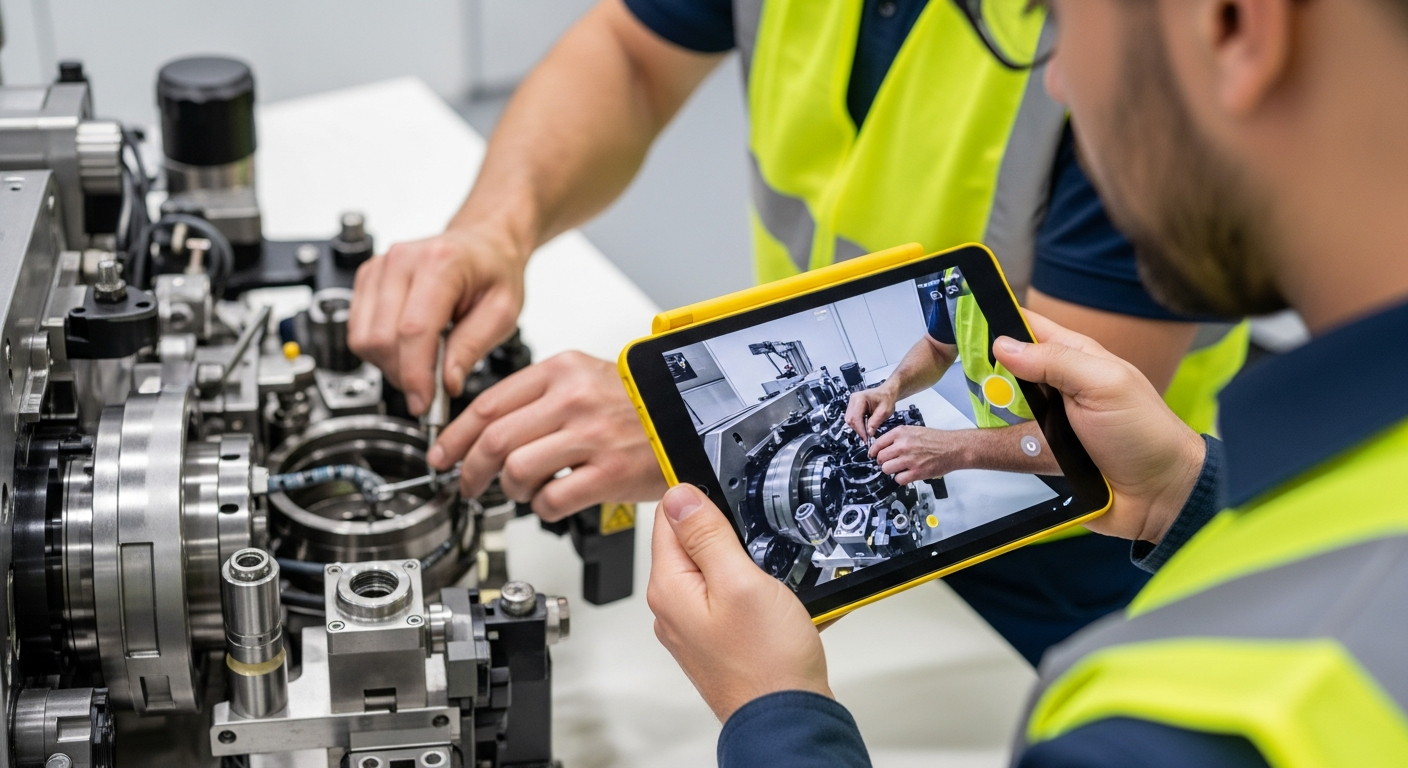
Traditional knowledge transfer asks experts to become technical writers. Visual capture reverses this: experts demonstrate while others document.
The methodology works through three steps: record the expert performing the task, AI extracts step-by-step instructions with visual confirmation, deploy through point-of-need access systems. This approach captures tacit knowledge that written procedures miss: the subtle adjustments, the warning signs, the troubleshooting intuition.
| Traditional Method | Visual Capture Method | Crisis Performance |
|---|---|---|
| Written SOPs | Video-to-guide AI | Access time |
| Expert writes procedure | Expert demonstrates task | 15-45 min vs 60 seconds |
| Text-only instructions | Visual steps + annotations | Multiple interpretations vs clear visual |
| Single language | Auto-translation to 200+ languages | Language barrier vs immediate access |
| Requires reading comprehension | Visual confirmation at each step | Error-prone vs self-validating |
Video capture isn't about creating training videos. It's about preserving the micro-decisions and contextual adjustments that separate novice performance from expert-level execution. Tools like Manual.to enable this visual capture and instant deployment through QR codes at machine level.
This approach doesn't work for everything. Complex troubleshooting trees with multiple decision branches still need written documentation. Visual capture excels at sequential procedures where the physical process can be demonstrated.
Knowledge Transfer Across Language Barriers: The European Manufacturing Reality

European manufacturing faces unique knowledge transfer challenges due to linguistic diversity. A procedure created in German must be accessible to Polish, Romanian, and Portuguese workers during emergency situations.
Traditional translation approaches fail under pressure. Professional translation takes weeks, costs thousands per document, and becomes obsolete as processes evolve. Emergency situations can't wait for translation services.
What most guides get wrong about multilingual knowledge transfer
They assume translation is about converting text from one language to another. In manufacturing emergencies, translation is about enabling action across cultural and linguistic contexts under extreme time pressure.
Real multilingual knowledge transfer systems adapt the entire interface, not just the words. Visual confirmation reduces dependency on language comprehension, while contextual translation preserves operational meaning rather than literal accuracy.
The solution combines visual demonstration with intelligent translation. Workers see the physical action while reading instructions in their native language. This dual-channel approach reduces cognitive load during stress situations, enabling faster and more accurate task execution.
Modern transformation digitale approaches integrate poka yoke error prevention with multilingual access systems, creating knowledge transfer networks that work across European manufacturing facilities.
Calculating Knowledge Transfer ROI: Beyond Training Metrics
Knowledge transfer ROI calculations must account for crisis prevention, not just training efficiency. Traditional metrics like completion rates and satisfaction scores miss the actual business impact.
The real ROI comes from prevented incidents: avoided downtime, reduced error rates, faster problem resolution during off-shifts. A lean manufacturing system measures knowledge transfer success by crisis response times, not training hours completed.
Calculate your knowledge transfer ROI using this framework: identify critical knowledge holders, estimate replacement costs, measure current crisis response times, calculate incident prevention value. Most organizations discover that knowledge transfer systems pay for themselves within 3-6 months through prevented emergencies alone.
Integration with quality control systems enables measurement of knowledge transfer impact on defect rates and MTTR improvements. OEE metrics show direct correlation between knowledge accessibility and overall equipment effectiveness.
How long does knowledge transfer take in manufacturing?
What is the biggest knowledge transfer challenge?
How do you transfer knowledge across language barriers?
What's the ROI calculation for knowledge transfer systems?
Why do documented knowledge transfer programs still fail?
What's the difference between knowledge management and knowledge transfer?
How do you measure knowledge transfer effectiveness?
When should you use standard operating procedure versus visual knowledge transfer?
Sources
- Deloitte Manufacturing Institute, "The Manufacturing Skills Gap Study", 2023
- McKinsey & Company, "Beyond hiring: How companies are reskilling to address talent gaps", 2023
- Society for Human Resource Management (SHRM), "What is the average cost-per-hire?", 2023
- Panopto, "The Cost of Lost Knowledge: How Tribal Knowledge Impacts Business Performance", 2022
- Manufacturing Today, "Cost of Unplanned Downtime in Manufacturing", 2024
Build Crisis-Ready Knowledge Transfer Systems
Stop losing critical expertise during emergencies and workforce transitions.
Try NowBook a Demo